Monday, 20 February 2017

Presentation & Triumph Arch

On Wednesday, 15th of February I had a presentation and its scope was to inform the tutors with the current progress on the dissertation. This was a good opportunity to talk about all the good and not so good occurrences in the project. 

The project is on track and re-scaled with a more appropriate timeline and cut out the over-scoped aspects such as all the organic modelling and the special effects. This also changed some of the milestones giving some extra room for more adjustments and iterations that might occur later in time.

By having these excluded from the Circus, it can now be more focused on creating a more achievable and consistent result, rather than having a little bit from everything. After just one week we received the feedback and grade back from the tutors and I am very satisfied with the overall result and progressing so far.

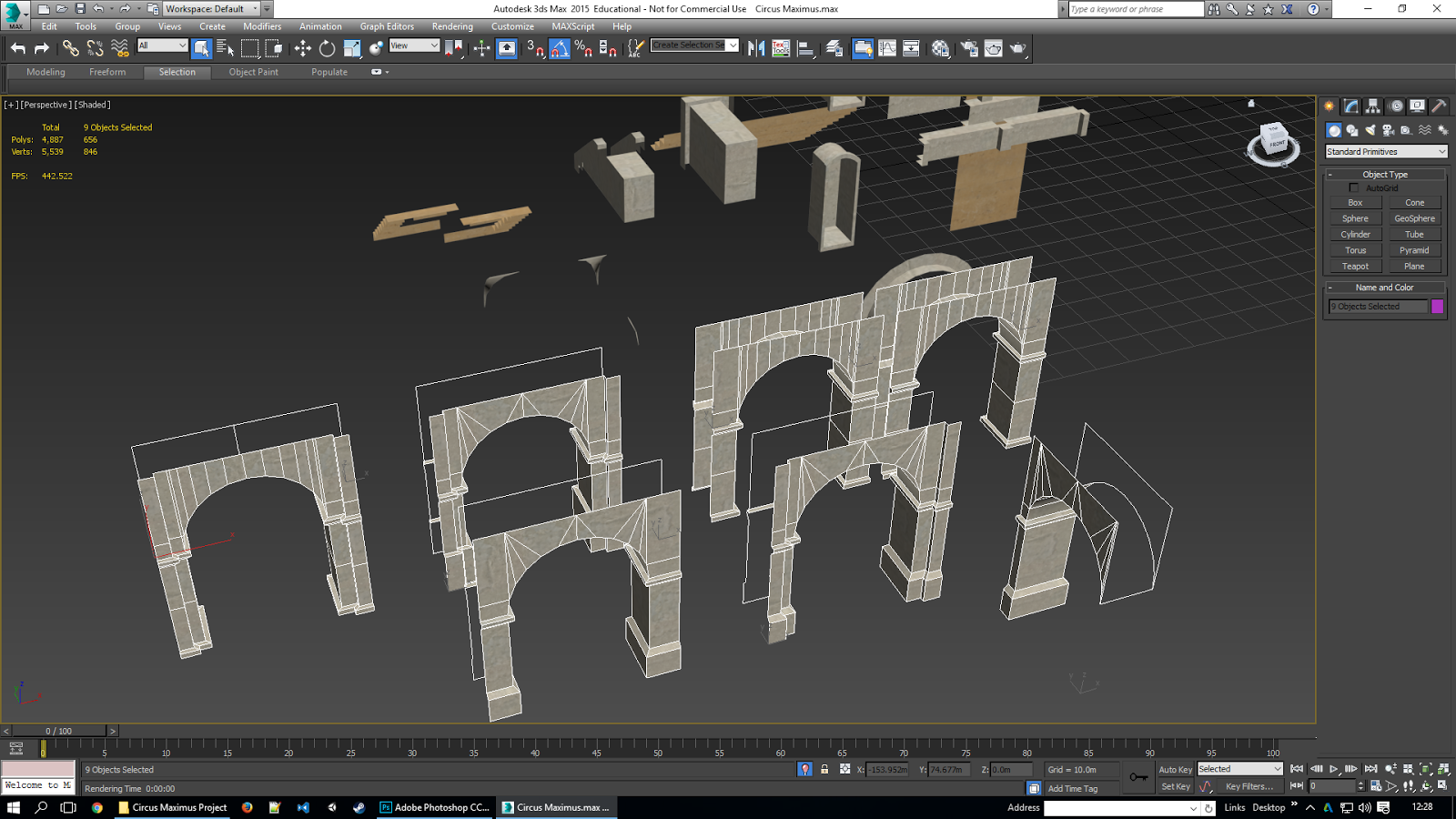
During that week and even before I have also been working on the triumph arch in the front of the circus. I tried to keep the texel density as even as possible and still use the existing textures. I had to sacrifice some of the squares in small places due to the shapes to be accurate but tried to keep them away from the main view. 

I had a very difficult time trying to find some references and close ups on the arch, but I found a good one that could serve as a replacement and has very similar details. Here are some photos of the Arch of Constantine:


This is a very good base and I tried to model the arch using the exact details and pieces. I also got a very interesting diagram defining the main shapes and silhouette. I have skipped modelling the statues or the reliefs on the arch as it takes too much time, but I will still try and use a combination of normal and height maps to suggest the details at least.


 Here I have some previews straight from Max's view-port:


 It might look repetitive in the most part even with the final textures, but that is why decals were invented and I will use some to break that tiling. So far I am still in the polygon budget and I putting as much time and effort in this as possible.

References

Cartwright, M., 2013. Ancient.eu. [Online]
Available at: http://www.ancient.eu/uploads/images/1266.jpg?v=1485680440
[Accessed 21 January 2017].
Mortel, R., 2012. Flickr. [Online]
Available at: https://www.flickr.com/photos/prof_richard/7949648384
[Accessed 21 January 2017].
Vizzutti, M., 2008. The Arch of Constantine: A Tool of Propaganda and Change for the Roman Empire. [Online]
Available at: http://honorsaharchive.blogspot.co.uk/2008/07/arch-of-constantine-tool-of-propaganda.html
[Accessed 22 January 2017].


Wednesday, 15 February 2017

The Pillar Completed

I finished with the pillar and I think it doesn't look that bad. I have used some new placeholder textures to get a feel for the decorative parts especially at the capital(top) of the column. The asset took me just over a week most of it spent modelling and unwrapping inside of 3Ds Max. The capital uses a unique texture, 1024 x 1024 in size, and the rest was modeled using the same technique as the stage.

This is a very important piece as I will end up using it in every other part that follows such as the pavilions in the spina(middle piece) or the Imperial Box. The poly count is not bad for the details and the textures definitely gives the desired look and also adds all the fine details.

Here I have some shots from 3Ds Max with the asset unwrapped and textured.
References


Starak, W., 2016. Textures.com - OrnamentsPillar0118. [Online]
Available at: http://www.textures.com/download/ornamentspillar0118/102920
[Accessed 14 January 2017].
Textures.com, 2016. Textures.com - GildedTrim0016. [Online]
Available at: http://www.textures.com/download/gildedtrim0016/100136
[Accessed 14 January 2017].
Textures.com, 2016. Textures.com - OrnamentBorder0115. [Online]
Available at: http://www.textures.com/download/ornamentborder0115/25454
[Accessed 14 January 2017].


Monday, 13 February 2017

Arches and problems...

As you can expect, every project has its own flaws and there is no perfect development, this one is no excuse. As I started creating the stage model I did have some difficulties in creating the right shapes and come across different types of architecture. I couldn't find a perfect representation for the Circus, especially close-ups. I relied on previous attempts of creation by other people, some video documentaries and also architecture theory and images of the parts needed.


As you can see I kept experimenting with different types of arches and vaults until I have reached the desired result. However, I am still working on it. I did several attempts in trying to get as many ideas out of my head to progress as fast as possible.


Thursday, 9 February 2017

Pillar

After finishing the arches I thought I will be done with the most tedious parts, I was so wrong. After I have consistently analyzing the references I found out that I don't have enough for what I need to do. So I started researching again in particular more buildings and structures built by the Romans so I can have an appropriate style to keep it consistent.

I found some video footage and it was in French. I didn't understand that much of the talking, but I got a more closer view on the actual architecture used not only for building the Circus but on the whole Rome. Also a website with someone trying to replicate the same building I am trying to make.

References

Ailes, D. R. E. D., 2016. Youtube. [Online]
Available at: https://www.youtube.com/watch?v=scEgv4ZX_0Q
[Accessed 22 January 2017].
Scoccimarro, D., 2014. Progetto Traiano. [Online]
Available at: http://www.progettotraiano.com/
[Accessed 22 January 2017].


Wednesday, 25 January 2017

Basic blocking out

Hello everyone,

Now I am going to show you my initial steps towards the construction of Circus Maximus. I started with sectioning the circus in large pieces to be easier to look at. I will follow a modular asset creation workflow because the majority of the shapes and forms were repeating.

Here is a draft of what I mean:


Then each and every piece have their smaller portions that needed to be built. For example for the imperial box is mostly built up with Corinthian pillars, then the arches from voussoirs, keystone, pier, plinth and so on.


Since this building will act as a landmark and will go in a MMOFPS game, I though that I should keep polys under control by having a 1024 x 1024 texture repeating all across the 3D Model so I began by defining a square with the texture on it as being my base unit to build the whole structure. Here is an example:


So here you can see my progress of how I built the stage piece starting with just one square, making the trims, windows, staircases and entrances and then finishing with a piece that has 2,500 polys which is very low poly compared to nowadays standards but considering the multiplayer aspect it might be helpful. This process took me approximately two week as I was also searching for more inspiration and references in the same time.

The main aim is to keep the texel density as even as possible all around the model. Another aspect as important is to not have illegal UV faces and to keep everything inside the 0 to 1 square as this is helping with having beautiful light-maps and not needing to do a second uv unwrap. I have some examples here:

The UV face needed to be overlapping because they could not fit in the square and keep the resolution even at the same time. And I will not bake any normal maps or ambient occlusion for these models otherwise the UV faces needed to be non-overlapping. The process becomes very straightforward once you practice a little bit and you eventually get the hang of it, although is time consuming.

References

Anon., 2016. Prehistory | Open Eyes. [Online]
Available at: https://dana123girl.wordpress.com/tag/prehistory/
[Accessed 2 December 2016].

Cartwright, M., 2013. Circus Maximus, Rome. [Online]
Available at: https://www.ancient.eu/image/1275/
[Accessed 20 November 2016].

Monday, 23 January 2017

The Concept Phase

I haven't posted something related to my work so far. Here are some early mood boards I have done before the beginning of the new year. Here are some paper representations and also different concepts of the dimensions of the circus and the contributing pieces.


As you may already know, my main objective is to reconstruct the Circus Maximus entirely and to make it a game ready asset. I included some of my reference regarding the architectural style used by Romans and some close ups on very important parts of the circus such as the pillars, arches and various details which will help me to get the representation as accurate as possible. Here are some examples.


Here are some placeholder textures I work with to get me a sense of how it should be looking when finished. I only have 2 for now, but I am planning to have a sheet of border and trim textures.


I will update some work in progress images on the further posts so you can see some proper 3D concepts and early block outs.

References

(ICAA), I. o. C. A. &. A., 2016. Carving. [Online]
Available at: https://www.pinterest.com/pin/333688653618507487/
[Accessed 24 November 2016].

Anon., 2016. Arh: Historical. [Online] 
Available at: https://www.pinterest.com/pin/98023729368238054/
[Accessed 21 November 2016].
Anon., 2016. Composite Order. [Online]
Available at: https://www.pinterest.com/pin/365073113516218748/
[Accessed 24 November 2016].
Anon., 2016. History of Rome. [Online]
Available at: https://www.pinterest.com/pin/318277898636783840/
[Accessed 21 November 2016].
Anon., 2016. Textures.com - ConcreteBare0182. [Online]
Available at: http://www.textures.com/download/concretebare0182/15478
[Accessed 24 November 2016].
Anon., 2016. Textures.com - ConcreteBare0371. [Online]
Available at: http://www.textures.com/download/concretebare0371/76124
[Accessed 25 November 2016].
Azalamb, H., 2016. Roma: Circus Maximus. [Online]
Available at: https://www.pinterest.com/pin/295126581801523401/
[Accessed 21 November 2016].
Cartwright, M., 2013. Circus Maximus, Rome. [Online]
Available at: https://www.ancient.eu/image/1275/
[Accessed 20 November 2016].
Geekamicus, 2016. History Geek. [Online]
Available at: https://www.pinterest.com/pin/246994360790896025/
[Accessed 21 November 2016].
Lawrence, C., 2016. Charioteer facts | Roman Mysteries. [Online]
Available at: http://www.romanmysteries.com/charioteer-facts
[Accessed 20 November 2016].
ONeill, L., 2016. Architecture of Andrea Palladio. [Online]
Available at: https://www.pinterest.com/pin/566468459360649162/
[Accessed 24 November 2016].
 

Monday, 16 January 2017

CD Projekt Red

These days I've watched some pretty interesting talks about CD Projekt Red, the guys that released The Witcher 3: Wild Hunt.

The first talk was hold by 2 developers from CD Projekt Red, an environment artist named Kacper and a concept artist named Marta. They started explaining the teamwork involved in creating The Witcher 3 Blood and Wine which is an expansion for the game. Marta begins to talk about the relationship between the concept art and environment art, and they discuss the iterations, draw backs and analysis of references they’ve gone through to finish multiple scenes in the game world.

They talk about the design process of the architecture and the link between the concepts and the art done by the teams. The task was very difficult especially keeping the relation between the book and the game and also making the player feel that the world has problems that needed to be solved. The benefits of working in a team is that the quality increases and also the inspiration you get by going out of the comfort zone helps you push further your ideas.
At the end there was a Q&A session where the team replied to the public regarding different subjects and topics. Producers and leads are always helping and keeping things on track minimizing wasted time.

Because things were getting pretty exciting, I watched a second talk from the CD Projekt Red studio because I wanted to know more about their way of thinking and managing different aspects of the game development. The name of the producer is Stan and he talks about the structure, and what it is involved in making art for the Witcher 3 and expansion packs along with it. He started with presenting the pipeline and how the assets priority is assigned based on how many departments will need to have a pass on it.

Optimization is an important aspect which takes place right at the end of the production and Stan is talking about what it takes to bring as much detail as possible in the characters and also keep the balance between details and frame rate by doing LODs (level of details) , shader LODs and so on.

He also talks about the importance of the little details and how that is dropping the quality of the game if not given enough attention, for example clipping. Different solution that might come across can vary from changing the angle of camera shots to trying to hide it with custom animations on every scene and some other ways, but in the end ask for help from coders.

When making repeatable or mass assets try and limit the amount of details like hair, cloth sim and movable parts as it might not be seen by the player and won't be noticed. Try to use simple elements like colors and patterns.

Human equipment was another interesting topic because they wanted the armour on the main character to be up-gradable and the player to be able to not only change between different types but to build upon the previous one. Also the armour needed to look good from behind as well. Sometimes it didn’t fit with the game so Stan talks about using a proxy high poly mesh to see the silhouette and make changes early on the production rather than wasting time.

The dismemberment was another aspect and the approach was consisting in preparing the types of bodies for all the types of characters in the game and then cover all of them in blood.
The presentation ended with a usual Q&A session.


References

DevGAMM Conference, 2015. Youtube. [Online]
Available at: https://www.youtube.com/watch?v=pzvkB3w1qXQ
[Accessed 16 January 2017].
Dragons, D., 2016. Youtube. [Online]
Available at: https://www.youtube.com/watch?v=J20Zd96i6oM
[Accessed 16 January 2017].